
Urban Spell Codification
Introduction
Mantra is part of Urban Spirit Studies (USS), a research initiative developed by Operations for Habitat Studies (OHS) in collaboration with Prof. Kenta Kishi (Akita University of Art/AUA), supported by the Grants-in-Aid for Scientific Research (KAKENHI) program.
This project examines how beliefs in spirits inform the organization of living spaces and everyday practices within Surabaya’s kampung communities-settlement environments largely inhabited by lower-income urban residents. Mantra investigates how these beliefs shape spatial practices across private and public realms, and considers their place within broader urban discourse.
Conventional urban “master planning”, which governs large-scale development, is typically formulated around economic rationality and city branding. In contrast, spatial adjustments enacted by individuals and communities -where residents cultivate their roots, relations, and identities-remain small in scale and are often overlooked within top-down planning frameworks. Despite their significance in shaping lived spaces, such situated transformations are frequently marginalized in dominant urban narratives.
Starting from this position, Mantra interrogates mechanisms of spatial production through an interdisciplinary approach bridging urban planning and social psychology. Through fieldwork, workshops, and literature studies, the project assembles narratives that form a “universe of mantras”: an intangible layer of rituals, memories, conversations, and everyday actions through which residents continually negotiate and inhabit their environments.
Urban Spell Codification
Urban Spell Codification is a workshop that builds upon the collection of 100 stories from 100 local residents across 11 Rukun Warga (RW) in the Kelurahan Genteng area, gathered through one month of intensive field research conducted by a multidisciplinary team of 10 researchers. Through attentive listening and documentation, these stories capture lived experiences, oral histories, local knowledge, and spatial understandings of everyday life. The workshop focuses on codifying these narratives into “urban spells” through processes of data categorization, thematization, and narrative structuring, transforming raw stories into meaningful cultural knowledge. The outcome will be a curated body of codified narratives representing 100 listeners and 100 storytellers, offering insight into the social, spatial, and experiential fabric of Kelurahan Genteng.

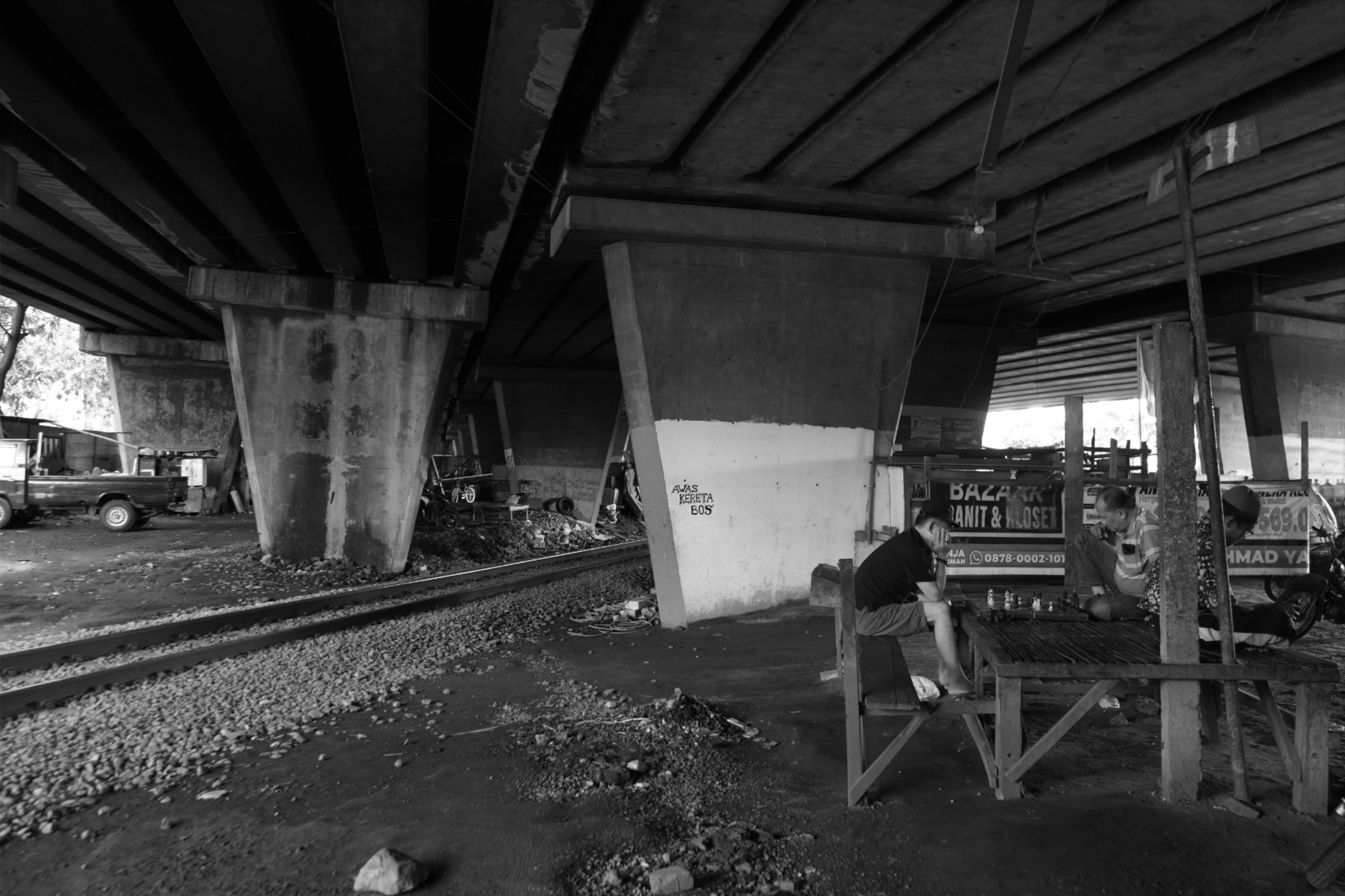
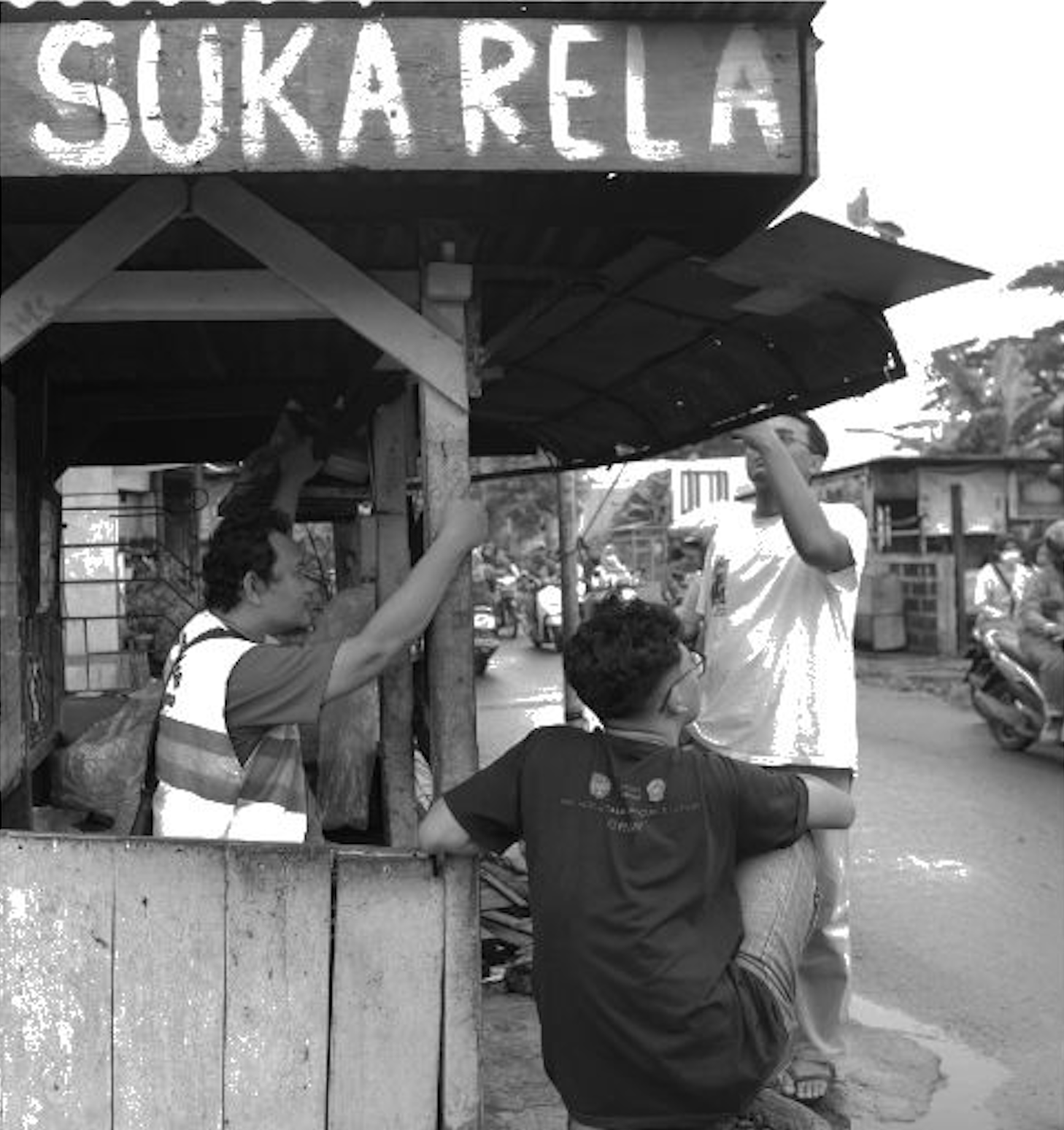
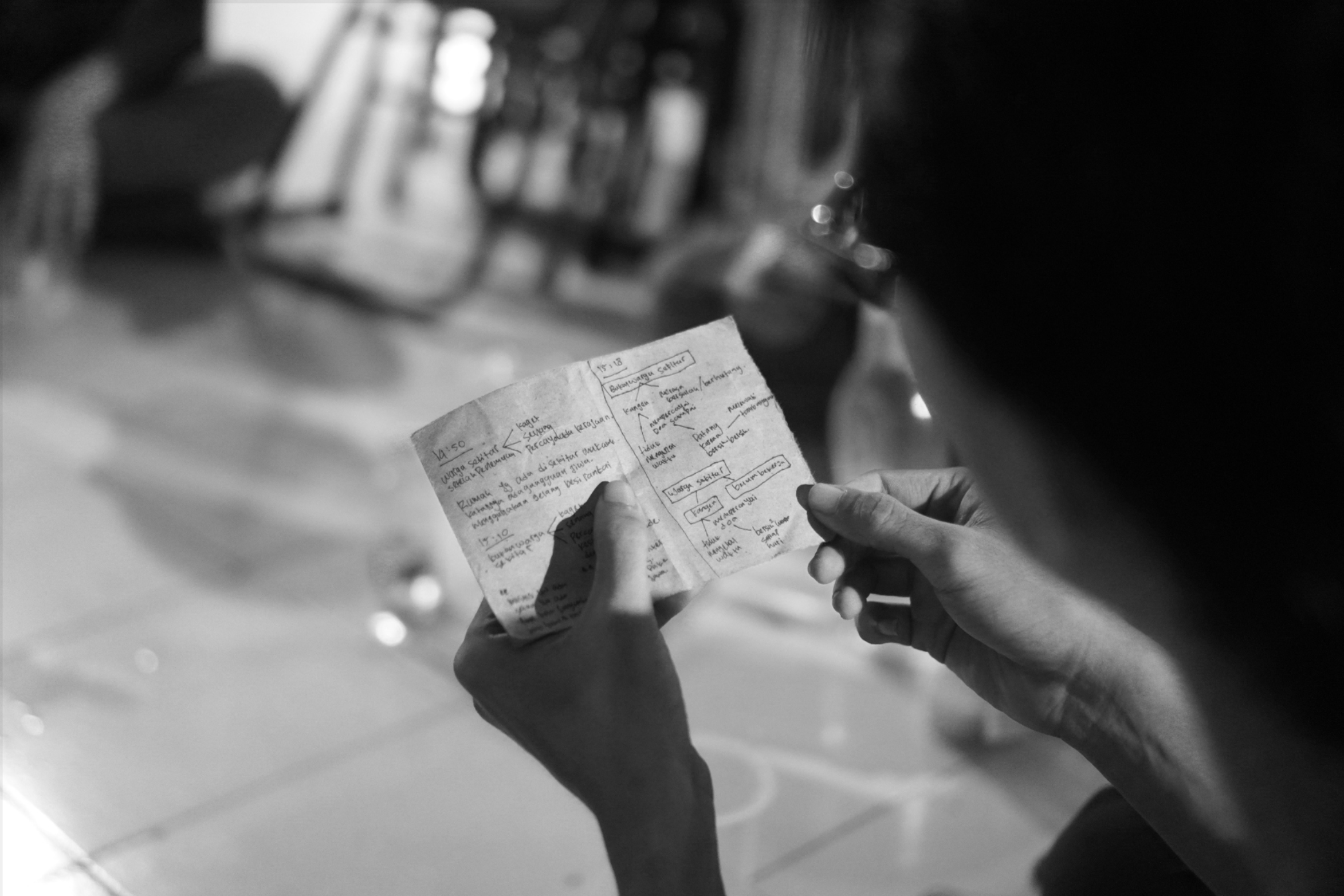
This research workshop is conducted in collaboration with the Faculty of Psychology, University of 17 Agustus 1945 Surabaya (UNTAG). The collaboration brings together field research and psychological perspectives, particularly in understanding lived experience, memory, belief systems, and everyday practices within urban communities. Through this partnership, the workshop is supported by academic expertise in qualitative research, ethical engagement with community narratives, and participatory methodologies, ensuring that the process of listening, analysis, and codification of residents’ stories is conducted with methodological rigor and sensitivity. The collaboration also strengthens the workshop’s role as a space for interdisciplinary exchange between researchers and academics in exploring urban life in Kelurahan Genteng.
Research Advisor
Prof. Kenta Kishi | Graduate School of Transdisciplinary Arts, Akita University of Art
Anugrah Yulianto Rachman | Anthropologist, OHS
Bintang Putra | Urban Researcher, OHS
Dr. Rr. Amanda Pasca Rini, M. Si. | Psychologist, Faculty of Psychology UNTAG Surabaya
Sayidah Aulia Ul Haque, M.Psi. | Psychologist, Faculty of Psychology UNTAG Surabaya
Yuriadi, S.Psi., MA | Psychologist, Faculty of Psychology UNTAG Surabaya
Sarah Innasari | Architect, OHS
Workshop Operations Team
Lutfiah Setyo Cahyani | Art and Urban Researcher, OHS
Researcher
Aditya Salim Ahnaf | Undergraduate Student of Anthropology, Airlangga University
Doni Rahma Raga P. | Undergraduate Student of Anthropology, Airlangga University
Adi Alghulam T. | Undergraduate Student of Anthropology, Airlangga University
Alfian Widi | History Researcher
Arif Bahtiar | Literature Critique
Putri Rachmahdani | Independent Researcher
Dinda Salsabila Fajaria Setiawan | Ketandan Youth Community (Kartar)
Location
Faculty of Psychology, University of 17 Agustus 1945 Surabaya (UNTAG)
East Java
Time and Schedule
7 – 11 January 2026 (5 days)
Previous Activity
Mantra: Urban Spirit Codex 1
The first fieldwork was conducted in Pagesangan Subdistrict, Jambangan District, Surabaya (February–March 2025). This area represents a suburban kampung context that still maintains a strong relationship with ancestral sites, green spaces, and traditional social structures. Key findings from the study in Pagesangan include:
- Unity of Sacred and Everyday Spaces: The punden (ancestral shrine), ancestral graves, and spiritual sites are intertwined with domestic activities, revealing the blurred boundaries between the profane and the sacred.
- Sound as Ritual: Sounds such as the call of the goak bird, the adzan (call to prayer), and the train crossing bells serve as markers of transition and invisible communication.
- Children’s Imaginative Space: Children’s play, influenced by the local legend of Mbah Pulosani, forms a spiritual space born from imagination.
- Objects as Mediators: Everyday items such as buckets, ropes, stones, and leaves act as mediators connecting humans with non-human entities.
These findings suggest that the beliefs in spirits and spiritual practices among kampung residents are not only manifested through formal rituals, but are also embedded in small gestures, conversations, and everyday sounds.
Mantra: Urban Spirit Codex 2 – Preliminary Studies
in Kelurahan Genteng (Oct. 13 – Nov. 13, 2025)
The relationship between belief systems, ancestral sites, and settlement development in Genteng is complex and deeply interwoven. The areas of RW 1–4 are closely associated with settlements built upon former Chinese burial grounds, while RW 5–11 demonstrate strong connections to belief practices tied to trade, punden traditions, and local mythologies. These include narratives linked to figures such as Sunan Ampel and the East Javanese folk hero Sawunggaling. Together, these layered stories and spatial configurations form the foundation of this preliminary study.
Building upon these spatial and cultural contexts, the research delves into the everyday practices, lived experiences, and oral narratives of Genteng’s residents. From 13 October to 13 November, a month-long fieldwork was conducted involving in-depth engagement with 100 residents across all 11 RWs. Through daily field notes and documented conversations, a body of stories was compiled, forming the primary material for the subsequent workshop process and serving as the basis for deeper analysis and codification.
 Operations for Habitat Studies